In any industrial project, the piping design It is one of the most critical disciplines for ensuring the viability, safety, and efficiency of a facility. However, many problems that arise during manufacturing and assembly originate in the early design phases, leading to delays, cost overruns, and unforeseen modifications.
What if it were possible to eliminate most of those issues from the start of the project?
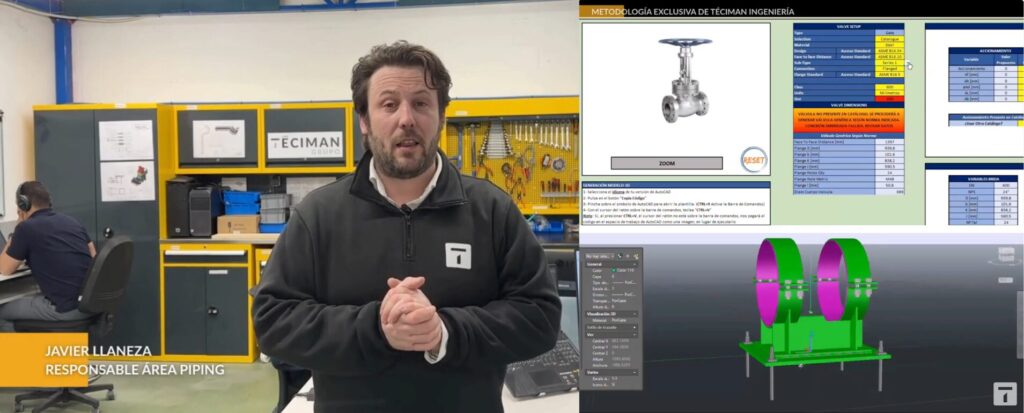
In Téciman Engineering we have developed a exclusive methodology which allows for the optimization of piping design through the centralization, analysis, and integration of all system elements from the earliest engineering stages.
The main challenge of piping design
Traditionally, many projects work with approximate models or standard solutions for certain components. While this approach can expedite some initial phases, it also introduces uncertainties that often arise later in the workshop or during plant assembly.
One of the elements where these deviations are most evident is the design of supports.
Supports are essential to ensure the stability, safety, and proper functioning of pipelines. However, when designed using approximations or generic models, the likelihood of incompatibilities, last-minute adjustments, and manufacturing errors increases.
Our piping design methodology
The difference in our approach lies in working on fully integrated and accurate models.
To achieve this, we developed:
- Exact 3D models of each support.
- Automatic adaptation to the actual conditions of each installation.
- Complete integration of all system elements: joints, anchors, sliding points and support.
- Complete coordination between design, manufacturing and assembly.
Thanks to this methodology, each component is developed considering its position and actual behavior within the installation as a whole.
Benefits of a more precise piping design
When the digital model accurately reflects what is going to be built, the results are immediate:
Elimination of uncertainties in workshop and assembly
Manufacturing teams have accurate and detailed information from the outset, reducing interpretations and subsequent modifications.
Reduction of design errors
By working with exact models, problems arising from interferences, incompatibilities, or incorrect construction solutions are minimized.
Direct generation of manufacturing drawings
The information needed for production is obtained directly from the model, accelerating processes and improving document quality.
Up to 35% less development time
Optimizing design and validation processes significantly reduces engineering timelines, providing a major competitive advantage for any industrial project.
The goal: to design exactly what will be built
Digitalization and precision in piping design are no longer an option, but a necessity to tackle increasingly complex industrial projects.
At Téciman Ingeniería we work to ensure that each designed element has an exact correspondence with the constructive reality, eliminating uncertainties, reducing errors and optimizing execution times.
The result is more efficient, more reliable engineering that is aligned with the real needs of manufacturing and assembly.
Want to discover how this methodology works and how it can be applied to your piping projects? Contact our team and learn firsthand about a solution that's already making a difference in the industry.
For more information, contact us by phone at 947 20 91 41 or by email at teciman@teciman.com. Follow us on LinkedIn to find out all the news.